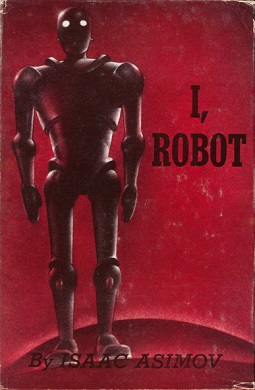
I, Robot, to say the least, has been one of the most well-known and influential science-fiction works of the 20th Century. Written by visionary Isaac Asimov, the book is famous for introducing key concepts of artificial intelligence, such as the 3 Laws of Robotics, that continue to influence the development of both science fiction and the ethics of artificial intelligence. It’s had such an impact on literature, that even today, the book still holds up quite well, and is cited by many as inspiration for their own works.
Consisting of 9 connected short stories spanning over more than half a century, Asimov serves to bring across to his audience what he perceives to be the evolution of robotics-from mute, crude automatons to massive artificial brains that dictate the flow of society- and express his hopes for mankind’s future with robotics. Granted, the stories were published in the 1940s, and so some of the story’s elements might seem dated, or even bizarre, but the basic themes and ideas remain just as relevant today, in an era where artificial intelligence is getting more intelligent than ever.
Throughout the different scenarios presented in each story, Asimov aims to show how robots could help improve mankind, as long as their actions can all stay within the ‘three laws of robotics,’ and ensure that no harm can come to any man. As straightforward as it sounds, Asimov skilfully creates differing situations, such as a robot gone mad due to over-exposure to sunlight, that demonstrate how these laws could be bent or upheld in the most bizarre of ways. I wish I could explain it a bit more, but the scenarios are unfortunately too complex to summarise in two lines, and I’m afraid you’re going to read through the book to understand the very intellectual arguments put forward by Asimov.
While I was reading this book, I couldn’t help but realise that perhaps, instead of the human or non-human characters populating the different stories, Asimov intended for the three laws themselves to be the main character of the book as a whole. After all, they formulate the basis of discussion around whether robots benefit humans or not, and despite the never-ending evolution of robots throughout the course of the book, the words that comprise of these laws remain the same, and continue to form the basis for robotics’ advancement. At times like these, I wonder if Asimov was trying to predict the future, and urging us to place these safeguards in place for all types of artificial intelligence, lest a Skynet-esque incident occurs within our lifetimes. Given his intelligence, though, I wouldn’t be surprised if he was.
So, to sum up my review in a few words, if you want to understand artificial intelligence, or if you fear the advent of robotics, read this book if you want to understand more about these subjects, or at least to soothe your fears. Don’t worry, robots aren’t here to take our jobs, they’re here to improve humanity.
TL;DR:
The Good: Interesting theories regarding the development of robotics and artificial intelligence, 9 fascinating stories, a holy grail for sci-fi fans
The Bad: Can get very philosophical, quite a bit dated
The ‘Eh’: The plot is spread out across 9 stories and 50 years, the robots aren’t the main characters (for those who do want them to be)
Conclusion: Pick this book up. In the 21st Century, its core message is probably more relevant than ever

 A Layman's Reviews