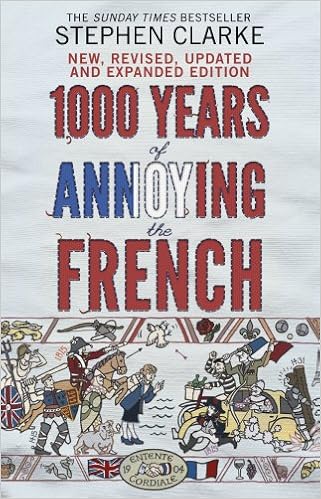
Book Review: 1000 Years of Annoying the French

Vive l’anglais!

The English and the French. Ever since William the Conqueror stepped onto the shores of England, the two countries have shared a contentious relationship with each other. Even today, you can find plenty of French-bashers in Britain, or plenty of English-haters in France who refuse to speak in the ‘Anglo-Saxon’ tongue when communicating with foreigners. At the same time, however, the two countries have proved themselves to be capable of cooperation (for limited periods of time), and remain firm allies of each other.

As well-known(or infamous) as this ‘frenemy’ phenomenon is, however, it can be quite hard to put this relationship down to one event. On the other hand, it is necessary to understand the shared history of both countries over more than 1000 years to truly experience the fervent love/hate they have for each other.

This is where this book comes in. 1o00 Years of Annoying the French is a comprehensive history of the Anglo-French relationship (from a very Anglophile perspective), that aims to catalogue almost every instance of the English uprooting the French in a tongue-in-cheek manner. From Joan of Arc to the Royal Wedding of Prince William and Kate, the author never fails to find an opportunity to mock the French and their bad luck when he sees one. Take the Battle of Waterloo for example. As we all know, Napoleon lost, and the Duke of Wellington became the national hero he is today. To add insult to injury, however, the author decides to remind the (probably already-incensed) Francophile readers that whenever they enter the British embassy in Paris, they will be greeted by a portrait of the Duke in grand old age as they explore its grounds. Other instances, such as the croissant being Austrian and the incompetence of modern French politicians, only serve to pour more salt on French wounds.

For all its mockery of the French, however, the book is surprisingly optimistic about Anglo-French relations in the future. Yes, the author says, the English will probably view themselves as better than the French, and the French-bashing shall go on, but that doesn’t mean there’s no room for cooperation-or, as he puts it-cooperation through gritted teeth. For as long as the two countries exist, they shall never end their rivalry.

TL;DR:

The Good: Surprisingly informative, very entertaining read

The Bad: Endlessly mocks the French (not a bad thing for me, but perhaps for those who are Francophiles), very biased to the English

The ‘Eh’: It’s very long (1000 years is a lot), some references might fly over your head

Conclusion: Recommended for all Anglophiles. Francophiles should be kept away from this book unless you want to see it in your garbage bin the next day.
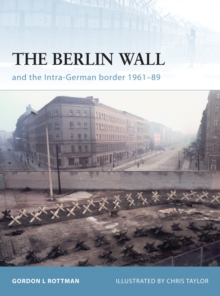
Book Review: The Berlin Wall and the Intra-German border 1961-89

Pretty self-explanatory

For those who were born after 1990 in some country other than Germany, or have completely blocked this period of time out of their heads, in the wake of the end of the Second World War, Germany, as well as its capital of Berlin, was divided up among the 4 major victorious powers-the US, UK, France and the former USSR- with each nation responsible for administrating its own sector. However, despite the arrangement originally meant to be temporary, as Cold War hostilities commenced over ideological differences between capitalism and communism, Germany soon found itself to be split into two separate countries-the pro-Western Federal Republic of Germany (aka West Germany, or Bundesrepublik Deutschland), and the communist German Democratic Republic (East Germany, or Deutsche Demokratische Republik). Berlin, similarly, found itself split into East Berlin and West Berlin, with both halves developing in their own distinct manner. 

While both Germanies became considerably well-off in their own ways throughout their existences, the severe tightening of freedoms, comparatively less economic choices, and the ever-omnipresent presence of the secret police( in this case, the infamous Stasi) meant that many living in the East were willing to take the risk to flee to the economically richer West, despite travel being severely restricted due to tense relations. As time went on, however, the outflow of refugees became problematic, as many of these were sorely-needed intellectuals and medical professionals, and it became necessary for the East German government to enact procedures to make sure its citizens stayed inside its own territory. This was where both the Berlin Wall and the Intra-German border, the subjects of this book, came into play.

A diagram of the border

 Throughout its relatively short length, the author, Gordon L. Rottman,  aims to examine how the fortifications of the inter-German borders were established, how they were manned, and whether they were actually effective. Digitally-rendered images of the Berlin Wall’s defences, from border posts to vehicle ditches to multiple layers of barbed wire, are all recreated in stunning detail in these diagrams and charts, serving to demonstrate to the reader the extent to which the East German government took measures to safeguard its borders. Similarly, the less-known Intra-German border is explained in just as much detail, though with much more photos than its Berlin counterpart due to its longer length. Numerous photos, as well as the author’s own analysis, serve to show the extent of division in Germany throughout the Cold War. Towns and houses were cut up, families were separated along the lines, and even beaches were patrolled by border guards to prevent any prospective defectors from having second thoughts. 

What perhaps struck me the most, while reading this book, was perhaps how much scrutiny was being placed by the East German government on keeping its citizens in. From the rather expensive Berlin Wall (and its multiple incarnations over the years as technology improved) to the sophisticated equipment utilized by East German border guards, it’s definitely surprising how fearful and paranoid East Germany was, though it can hardly be blamed when it found itself on the frontlines of the Cold War with its Western counterpart, and given the many skirmishes in Berlin, such as the Checkpoint Charlie incident of 1961. 

Thankfully, as we all know, as the USSR imploded, and various Warsaw pact countries including East Germany faced widespread unrest, the Berlin Wall was finally torn down, and the two Germanies were reunited in 1990 after almost 50 years. At the same time, the Intra-German border lost its use, and was similarly removed by former East German soldiers contracted by the German Army. While the Wall and the border don’t exist anymore, remnants of their legacy remain in some isolated areas, and in the minds of Germans, reflecting the enormous task of reuniting a country after half a century of division and hostility.

For a history enthusiast like me, this book should be in your collection. However, those who are just casual readers and don’t have that strong of a grasp of politics may find themselves overwhelmed by the swath of technical detail and the many confusing terms (the book chooses to use German terms where applicable.) So while I can’t really recommend this to everyone, you are free to pick this book up if you’re interested.

TL;DR:

The Good: Detailed diagrams and graphs, countless historical photos for reference

The Bad: Very specialised subject, lots of technical jargon

The Eh: You might want to take a crash course in German history or ask your German friends on their take of it (if they’re old enough) before reading this

Conclusion: Recommended for some, but not all.